Landscape Design and Ecological Restoration
January 9, 2024
Let’s Talk About Lesser Celandine
January 9, 2024
By: Jenna Roller-Knapp
March 1, 2021
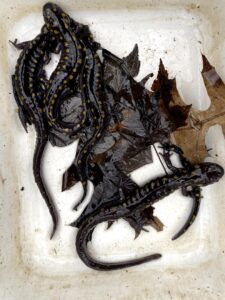 Most of the salamanders in the family Ambystomatidae spend between 70 to 95 percent of their lives underground, hence why they are called mole salamanders. This includes Jefferson, spotted, eastern tiger, small-mouthed, marbled, blue-spotted (state endangered), streamside and unisexual hybrid salamanders. They come to vernal pools at night, often during the first warm rain in late winter to breed. This typically in occurs late January to early February in the southern portions of Ohio and through late march in the northern parts of the state. Though most live within the same 100 meters of their breeding pool, males are often the first to arrive. Their presence leaves chemical scents which then attract females to the water. Once together, they share a “dance” in which the males show off with a tail waggling display and then both sexes swim around each other.
The adult salamanders are present in pools for a short time, often just one to two weeks. The males deposit spermatophores (up to 80 per male) on leaves and sticks underwater. They lead females to the area in hopes that they will accept this donation and use it to fertilize their eggs. Females release an average of 200 eggs within a thick, firm, jelly-like mass, which is often attached to woody debris in the water in secretive locations. Some salamander species will stay nearby and guard the eggs from predators, however others, such as spotted salamanders, make no further investment of parental care. Males typically stay longer in the pool, likely to increase their chance of fertilizing more eggs. The egg mass provides moisture needed to survive as water levels fluctuate. The eggs masses are distinguishable by species based on shape, deposition location, and amount of eggs per mass.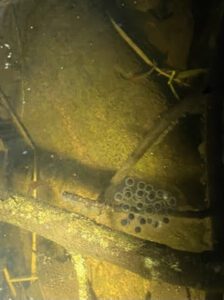
Salamanders return underground by way of abandoned burrows of small mammals or crayfish, however the eastern tiger salamander is a proficient digger and can make its own tunnels. These tunnels vary between 1-1.5 meters in depth. Here they spend the majority of their lives, consuming invertebrates and are kept safe from freezing temperatures in winter. They do not eat during the winter, but rely on their fat storages. They will not eat again until after they have bred. In vernal pools, they eat small critters including zooplankton, fairy shrimp, spiders and worms, mosquito larvae and flies. Sometimes, especially when the pool is drying up or in times of overcrowding, they may eat other salamanders! In turn, salamander eggs are often preyed upon by adult newts, wood frog tadpoles, crayfish, and some species of caddisfly. Adult salamanders are preyed upon by birds and snakes.
The eggs that successfully develop in the vernal pool metamorphose into small larvae. The length this that process is determined by the amount of water in the pool. They will develop visible feathery gills at the base of their head, and when they become adults, they lose these gills and transition to breathing by lungs, gain eyelids and a tongue. Tiger salamanders develop more slowly and often need water present through about August, but their metamorphosis, like other salamanders, can speed up if they sense the water is drawing down.
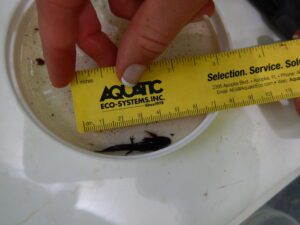 When a salamander is mature (variable by species but typically after several years), they will try to return to the wetlands in which they were conceived, even if another pool is closer, or if moved hundreds of meters away. It is not known exactly how they do this, but chemical cues are probably important. Vernal pools and their forested buffers are critical for these salamanders to persist. These are safe areas to breed because they are seasonally dry and thus cannot support fish or other predatory residents. Leaves, sticks, logs, and other forest debris from the surrounding trees offers the cover and structure within the wetlands that these special animals have evolved to inhabit.
We hope you enjoy these amphibian harbingers of spring as much as we do!